Pharmacology of type 2 diabetes mellitus and skeletal muscle: detect, prevent, treat
DOI:
https://doi.org/10.47196/diab.v60i3.1577Keywords:
pharmacology, type 2 diabetes mellitus, skeletal muscle, detection, prevention, treatmentAbstract
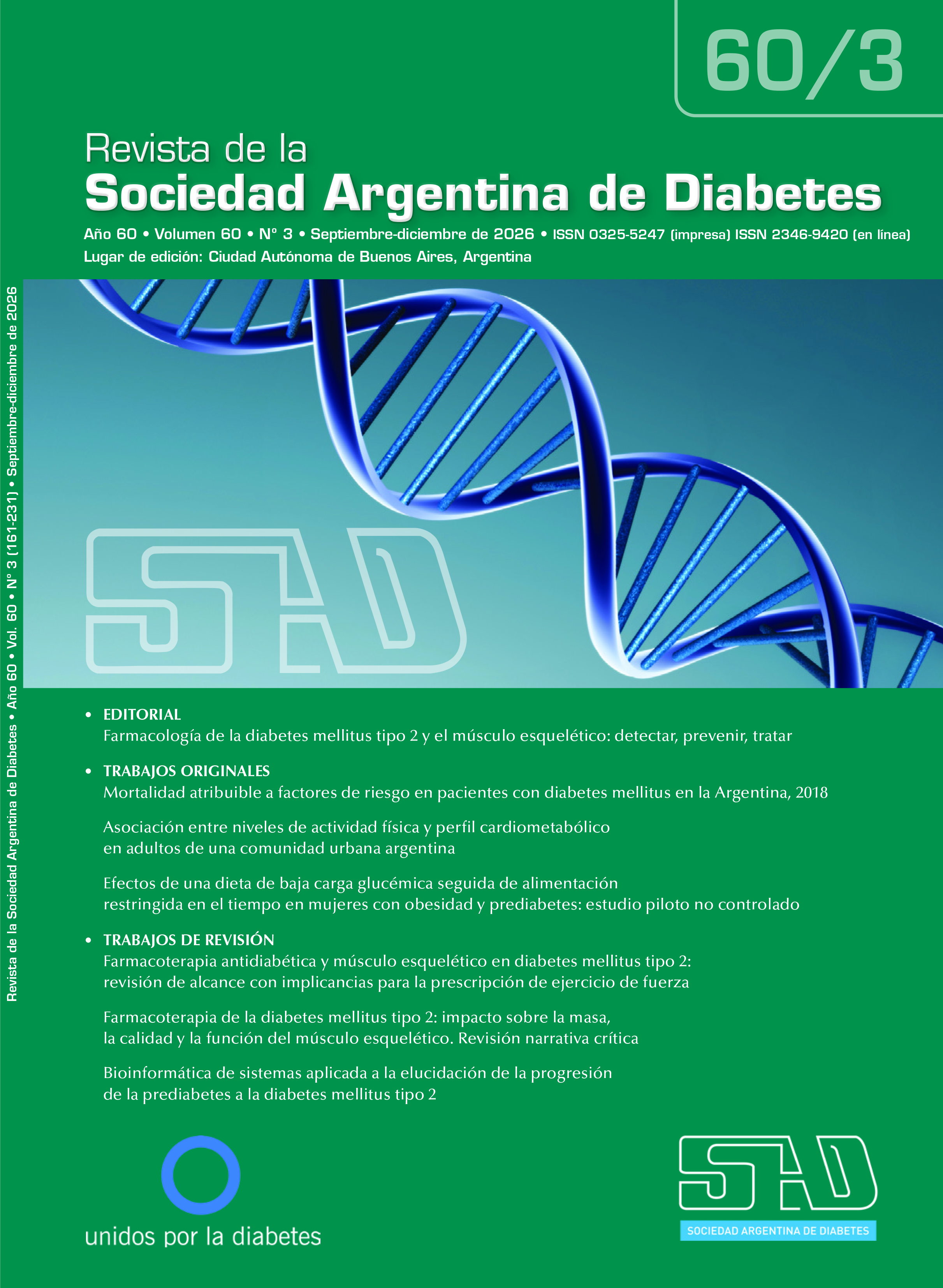
In this issue of the journal of the Argentine Diabetes Society (SAD), two reviews are published regarding the pharmacotherapy of type 2 diabetes (T2D) and its effects on skeletal muscle; I will refer to these briefly before providing a historical overview of the role of muscle in diabetes.
References
I. Prentice AM, Jebb SA. Obesity in Britain: gluttony or sloth? BMJ. 1995;311(7002):437-9. doi: 10.1136/bmj.311.7002.437.
II. DeFronzo RA, Tripathy D. Skeletal muscle insulin resistance is the primary defect in type 2 diabetes. Diabetes Care. 2009;32(Suppl 2):S157-63. doi: 10.2337/dc09-S302.
III. Samuel VT, Shulman GI. Mechanisms for insulin resistance: common threads and missing links. Cell. 2012;148(5):852-71. doi: 10.1016/j.cell.2012.02.017.
IV. Cruz-Jentoft AJ, Bahat G, Bauer J, Boirie Y, Bruyère O, Cederholm T, et al. Sarcopenia: revised European consensus
on definition and diagnosis. Age Ageing. 2019;48(1):16-31. doi: 10.1093/ageing/afy169.
V. Lin D, Zhang L, Huang C, Shao W. Skeletal muscle metabolism in health and disease: mechanisms, interventions, and clinical perspectives. iScience. 2026;29(3):115024. doi: 10.1016/j.isci.2026.115024.
Downloads
Published
Issue
Section
License
Copyright (c) 2026 on behalf of the authors. Reproduction rights: Argentine Diabetes Society

This work is licensed under a Creative Commons Attribution-NonCommercial-NoDerivatives 4.0 International License.
Dirección Nacional de Derecho de Autor, Exp. N° 5.333.129. Instituto Nacional de la Propiedad Industrial, Marca «Revista de la Sociedad Argentina de Diabetes - Asociación Civil» N° de concesión 2.605.405 y N° de disposición 1.404/13.
La Revista de la SAD está licenciada bajo Licencia Creative Commons Atribución – No Comercial – Sin Obra Derivada 4.0 Internacional.

Por otra parte, la Revista SAD permite que los autores mantengan los derechos de autor sin restricciones.