
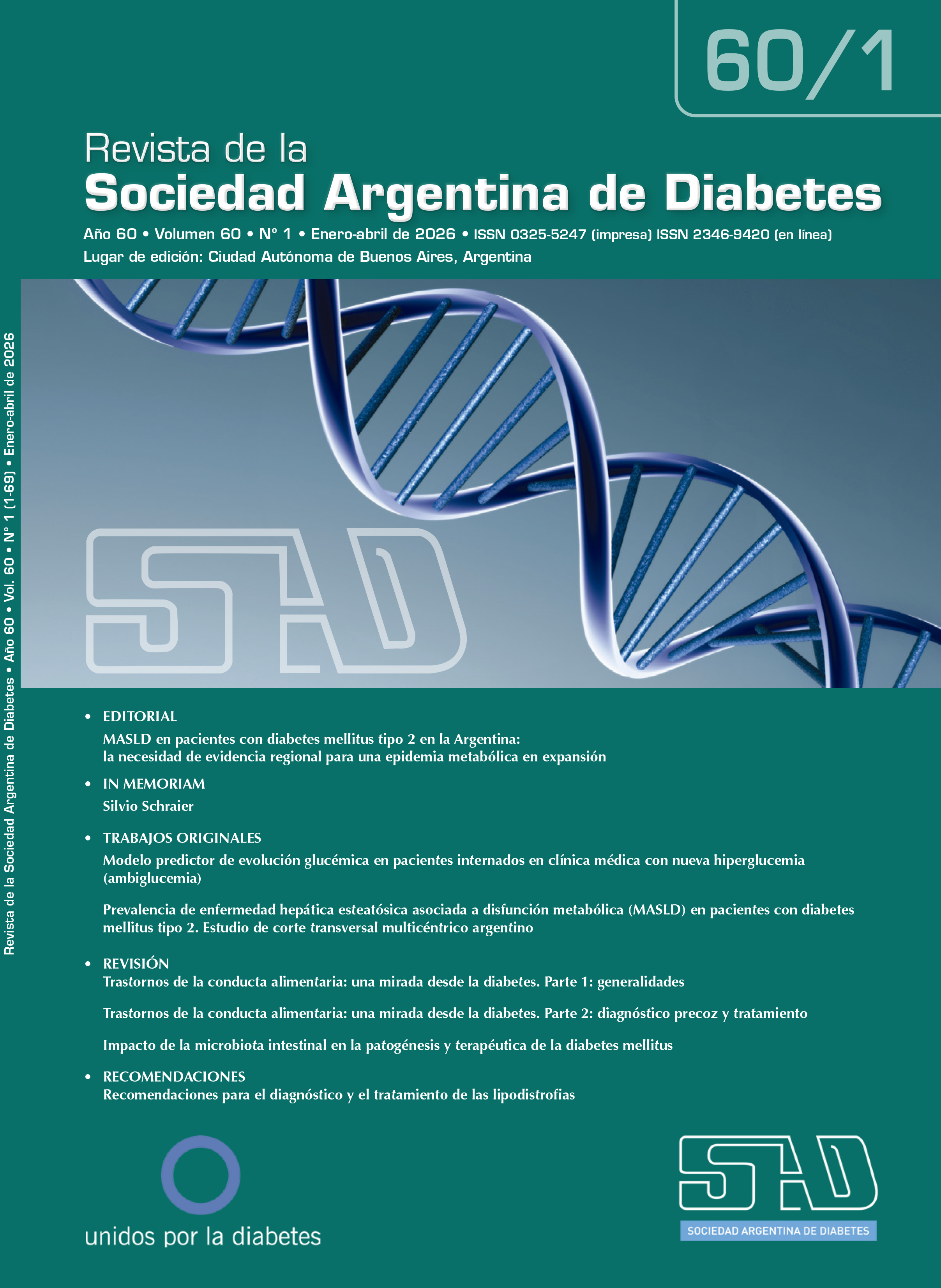
Recomendaciones para el diagnóstico y el tratamiento de las lipodistrofias
DOI:
https://doi.org/10.47196/diab.v60i1.1321Palabras clave:
recomendaciones, lipodistrofias, diagnóstico, tratamientoResumen
Introducción: las lipodistrofias son trastornos poco frecuentes caracterizados por la pérdida parcial o generalizada del tejido adiposo, con consecuencias metabólicas graves. Su baja prevalencia y heterogeneidad clínica dificultan el diagnóstico precoz y el abordaje terapéutico adecuado.
Objetivos: establecer recomendaciones nacionales para el diagnóstico y el tratamiento de las lipodistrofias, estandarizando criterios clínicos y genéticos, y proponiendo intervenciones terapéuticas basadas en la evidencia y experiencia clínica.
Materiales y métodos: revisión narrativa de la literatura científica y de consensos internacionales elaborada por referentes convocados por la Sociedad Argentina de Diabetes por su reconocida experticia en el tema. Se designó a un responsable diferente de los autores para la compilación final.
Resultados: se definieron criterios diagnósticos para lipodistrofias generalizadas congénitas y adquiridas. Se describieron seis subtipos de lipodistrofias parciales familiares, con sus respectivas alteraciones genéticas, distribución del tejido adiposo y comorbilidades metabólicas. Se establecieron pautas específicas sobre los componentes del estilo de vida, alimentación y actividad física, y se propusieron adaptaciones en función de las comorbilidades cardiometabólicas. Se detallaron estrategias farmacológicas, incluyendo uso de metformina, insulinas concentradas, tiazolidinedionas y agonistas de GLP-1, con evidencia preliminar de eficacia en subtipos seleccionados.
Conclusiones: este documento constituye una herramienta integral para mejorar el reconocimiento precoz, la caracterización genético-clínica y el tratamiento personalizado de las lipodistrofias. Su implementación busca reducir las complicaciones metabólicas, mejorar la calidad de vida y fomentar la investigación colaborativa en enfermedades raras.
Citas
I. Araújo-Vilar D, Santini F. Diagnosis and treatment of lipodystrophy: a step-by-step approach. J Endocrinol Invest 2019 42(1):61-73.
II. Lightbourne M, Brown RJ. Genetics of lipodystrophy. Endocrinol Metab Clin North Am 2017;46(2):539-54.
III. Brown RJ, Araujo-Vilar D, Cheung PT, Dunger D, Garg A, Jack M, et al. The diagnosis and management of lipodystrophy síndromes. A multi-society practice guideline. Journal of Clinical Endocrinology and Metabolism 2016;101(12):4500-11.
IV. González-Rodríguez M, Fernández-Pombo A, Sánchez-Iglesias S, Araújo-Vilar D. Guía Nutricional para las Lipodistrofias. AELIP, editor. AELIP. 2019. Disponible en: https://aelip.es/wp-content/uploads/2024/09/Guia-Nutricional-para-las-Lipodistrofias.pdf.
V. Araújo-Vilar D, Sánchez-Iglesias S, Guillín-Amarelle C, Fernández-Pombo A. Guía práctica para el diagnóstico y tratamiento de las lipodistrofias infrecuentes. AELIP, editor. 2018. Disponible en: https://aelip.es/wp-content/uploads/2024/09/Guia-practica-para-el-diagnostico-y-tratamiento-de-las-Lipodistrofias-infrecuentes.pdf.
VI. Patni N, Garg A. Lipodystrophy for the diabetologist. What to look for. Curr Diab Rep 2022;22(9):461-70.
VII. Özen S, Akıncı B, Oral EA. Current diagnosis, treatment and clinical challenges in the management of lipodystrophy syndromes in children and young people. JCRPE 2020;12(1):17-28.
VIII. Garg A. Lipodystrophies: Genetic and acquired body fat disorders. JCEM 2011;96(11):3313-25.
IX. Garg A. Acquired and inherited lipodystrophies. NEJM 2004;350(12):1220-34.
X. Rena G, Pearson ER, Sakamoto K. Molecular mechanism of action of metformin: Old or new insights? Diabetologia 2013;56(9):1898-906.
XI. Cochran E, Musso C, Gorden P. The of use of U-500 in patients with extreme insulin resistance. Diabetes Care 2005;28(5):1240-4.
XII. Sklate R, Houssay S, García A, Montero C, Rey R. Tumor de células de la granulosa ovárica en paciente con síndrome de Sheehan asociado a lipodistrofia parcial familiar variedad Dunnigan: desafío clínico-terapéutico. IV Congreso Internacional de Clínica y Medicina Interna / IV Congreso Argentino de Clínica Médica. Abstract nº 10506.
XIII. Karges B, Boehm BO, Karges W. Early hypoglycaemia after accidental intramuscular injection of insulin glargine. Diabetic Medicine 2005;22(10):1444-5.
XIV. Bolli GB, Owens DR. Insulin glargine. Lancet 2000;356(9228):443-5.
XV. Hussain I, Garg A. Lipodystrophy syndromes. Endocrinol Metab Clin North Am 2016;45(4):783-97.
XVI. Luedtke A, Boschmann M, Colpe C, Engeli S, Adams F, Birkenfeld AL, et al. Thiazolidinedione response in familial lipodystrophy patients with LMNA mutations: A case series. Hormone and Metabolic Research 2012;44(4):306-11.
XVII. Simha V, Rao S, Garg A. Prolonged thiazolidinedione therapy does not reverse fat loss in patients with familial partial lipodystrophy, Dunnigan variety. Diabetes Obes Metab 2008;10(12):1275-6.
XVIII. Moreau F, Boullu-Sanchis S, Vigouroux C, Lucescu C, Lascols O, Sapin R, et al. Efficacy of pioglitazone in familial partial lipodystrophy of the Dunnigan type: a case report. Diabetes Metab 2007 Nov;33(5):385-9.
XIX. Sleilati GG, Leff T, Bonnett JW, Hegele RA. Efficacy and safety of pioglitazone in treatment of a patient with an atypical partial lipodystrophy syndrome. Endocrine Practice 2007;13(6):656-61.
XX. Iwanishi M, Ebihara K, Kusakabe T, Chen W, Ito J, Masuzaki H, et al. Clinical characteristics and efficacy of pioglitazone in a Japanese diabetic patient with an unusual type of familial partial lipodystrophy. Metabolism. 2009 Dec;58(12):1681-7.
XXI. Arioglu E, Duncan-Morin J, Sebring N, Rother KI, Gottlieb N, Lieberman J, et al. Efficacy and safety of troglitazone in the treatment of lipodystrophy syndromes. Ann Intern Med 2000;133(4):263-74.
XXII. Foss-Freitas MC, Imam S, Neidert A, Gomes AD, Broome DT, Oral EA. Efficacy and safety of glucagon like peptide 1 agonists in a retrospective study of patients with familial partial lipodystrophy. Diabetes Care 2024;47(4):653-9.
XXIII. Valerio CM, De Almeida JS, Moreira RO, Aguiar LBS, Siciliano PO, Carvalho DP, et al. Dipeptidyl peptidase-4 levels are increased and partially related to body fat distribution in patients with familial partial lipodystrophy type 2. Diabetol Metab Syndr 2017 Apr 24;9(1).
XXIV. Tong J, Sandoval DA. Is the GLP-1 system a viable therapeutic target for weight reduction? Rev Endocr Metab Disord 2011 Sep;12(3):187-95.
XXV. Meral R, Celik Guler M, Kaba D, Prativadi J, Frontera ED, Foss-Freitas MC, et al. Metabolic improvements with tirzepatide in lipodystrophy: a novel option? Diabetes Care 2025;48(5):756-62.
XXVI. Melvin A, Adams C, Flanagan C, Gaff L, Gratton B, Gribble F, et al. Roux-en-Y gastric bypass surgery in the management of familial partial lipodystrophy type 1. JCEM 2017;102(10):3616-20.
XXVII. Fujita Y, Inagaki N. Renal sodium glucose cotransporter 2 inhibitors as a novel therapeutic approach to treatment of type 2 diabetes: Clinical data and mechanism of action. J Diabetes Investig 2014;5(3):265-75.
XXVIII. González-Clavijo AM, Fierro-Maya LF, Muñoz-Loaiza JD, Perilla-Roa D, Pérez-Moreno EJ, Guzmán-Rojas JD, et al. Use of metformin and an SGLT2 inhibitor to treat congenital generalized lipodystrophy. Case report. Revista Facultad de Medicina. 2020 Oct 1;68(4):639-43.
XXIX. Bansal R, Cochran E, Startzell M, Brown RJ. Clinical effects of sodium-glucose transporter type 2 inhibitors in patients with partial lipodystrophy. Endocrine Practice 2022;28(6):610-4.
XXX. Oral EA, Simha V, Ruiz E, Andewelt A, Premkumar A, Snell P, et al. Leptin-replacement therapy for lipodystrophy. NEJM 2002;346(8):570-8.
XXXI. Tsoukas MA, Mantzoros CS. Lipodystrophy syndromes. 7th ed. Larry Jamenson J, De Groot J, Eds. 2015;Vol. 2.
XXXII. Food and Drug Administration. Myalepta 2020 May. Disponible en: www.fda.gov/medwatch.
XXXIII. European Medicines Agency. Myalepta European Medicines Agency 2025. Disponible en: https://www.ema.europa.eu/en/medicines/human/EPAR/myalepta
XXXIV. Agência Nacional de Vigilância Sanitária - Anvisa. Myalept (metreleptina): novo registro. 2023. Disponible en: https://www.gov.br/anvisa/pt-br/assuntos/medicamentos/novos-medicamentos-e-indicacoes/myalept-metreleptina-novo-registro.
XXXV. Meral R, Malandrino N, Walter M, Neidert AH, Muniyappa R, Oral EA, et al. Endogenous leptin concentrations poorly predict metreleptin response in patients with partial lipodystrophy. JCEM 2022;107(4):e1739-51.
XXXVI. McDuffie JR, Riggs PA, Calis KA, Freedman RJ, Oral EA, DePaoli AM, et al. Effects of exogenous leptin on satiety and satiation in patients with lipodystrophy and leptin insufficiency. JCEM 2004;89(9):4258-63.
XXXVII. Moran SA, Patten N, Young JR, Cochran E, Sebring N, Reynolds J, et al. Changes in body composition in patients with severe lipodystrophy after leptin replacement therapy. Metabolism 2004;53(4):513-9.
XXXVIII. Ebihara K, Kusakabe T, Hirata M, Masuzaki H, Miyanaga F, Kobayashi N, et al. Efficacy and safety of leptin-replacement therapy and possible mechanisms of leptin actions in patients with generalized lipodystrophy. JCEM 2007;92(2):532-41.
XXXIX. Schlögl H, Müller K, Horstmann A, Miehle K, Püschel J, Villringer A, et al. Leptin substitution in patients with lipodystrophy: Neural correlates for long-term success in the normalization of eating behavior. Diabetes 2016;65(8):2179-86.
XL. Schlögl H, Müller K, Horstmann A, Pleger B, Miehle K, Möller H, et al. Leptin-substitution in patients with congenital lipodystrophy increases connectivity in reward-related brain structures: an fMRI study. Exp Clin Endocrinol Diabet 2014;122(03):OP3_07.
XLI. Schlögl H, Horstmann A, Miehle K, Möller H, Müller K, Pleger B, et al. Leptin-substitution increases connectivity in reward-related brain areas in patients with congenital lipodystrophy Stockholm: EASD; 2015. Disponible en: https://www.easd.org/media-centre/#!resources/leptin-substitution-increases-connectivity-in-reward-related-brain-areas-in-patients-with-congenital-lipodystrophy
XLII. Meehan CA, Cochran E, Kassai A, Brown RJ, Gorden P. Metreleptin for injection to treat the complications of leptin deficiency in patients with congenital or acquired generalized lipodystrophy. Expert Rev Clin Pharmacol 2016;9(1):59-68.
XLIII. Maguire M, Lungu A, Gorden P, Cochran E, Stratton P. Pregnancy in a woman with congenital generalized lipodystrophy leptin’s vital role in reproduction. Obstetrics and Gynecology 2012;119(part 2):452.5.
XLIV. Javor ED, Cochran EK, Musso C, Young JR, DePaoli AM, Gorden P. Long-term efficacy of leptin replacement in patients with generalized lipodystrophy. Diabetes 2005 Jul [;54(7):1994-2002.
XLV. Brown RJ, Oral EA, Cochran E, Araújo-Vilar D, Savage DB, Long A, et al. Long-term effectiveness and safety of metreleptin in the treatment of patients with generalized lipodystrophy. Endocrine 2018;60(3):479-89.
XLVI. Cook K, Adamski K, Gomes A, Tuttle E, Kalden H, Cochran E, et al. Effects of metreleptin on patient outcomes and quality of life in generalized and partial lipodystrophy. J Endocr Soc 2021;5(4).
XLVII. Aotani D, Ebihara K, Sawamoto N, Kusakabe T, Aizawa-Abe M, Kataoka S, et al. Functional magnetic resonance imaging analysis of food-related brain activity in patients with lipodystrophy undergoing leptin replacement therapy. JCEM 2012 Oct;97(10):3663-71.
XLVIII. Oral EA, Gorden P, Cochran E, Araújo-Vilar D, Savage DB, Long A, et al. Long-term effectiveness and safety of metreleptin in the treatment of patients with partial lipodystrophy. Endocrine 2019 Jun 15 ;64(3):500-11.
XLIX. Petersen KF, Oral EA, Dufour S, Befroy D, Ariyan C, Yu C, et al. Leptin reverses insulin resistance and hepatic steatosis in patients with severe lipodystrophy. J Clin Invest 2002 May 15;109(10):1345-50.
L. Muniyappa R, Brown RJ, Mari A, Joseph J, Warren MA, Cochran EK, et al. Effects of leptin replacement therapy on pancreatic β-cell function in patients with lipodystrophy. Diabetes Care 2014;37(4):1101.
LI. Vatier C, Fetita S, Boudou P, Tchankou C, Deville L, Riveline JP, et al. One-year metreleptin improves insulin secretion in patients with diabetes linked to genetic lipodystrophic syndromes. Diabetes Obes Metab 2016;18(7):693-7.
LII. Quaye E, Chacko S, Startzell M, Brown RJ. Leptin decreases gluconeogenesis and gluconeogenic substrate availability in patients with lipodystrophy. JCEM 2024;109(1):e209-15.
LIII. Lightbourne M, Wolska A, Abel BS, Rother KI, Walter M, Kushchayeva Y, et al. Apolipoprotein CIII and angiopoietin-like protein 8 are elevated in lipodystrophy and decrease after metreleptin. J Endocr Soc 2021;5(2):1-15.
LIV. Adamski K, Cook K, Gupta D, Morris E, Tuttle E, Carr E, et al. Effects of metreleptin in patients with lipodystrophy with and without baseline concomitant medication use. Curr Med Res Opin 2021;37(11):1881-9.
LV. Mosbah H, Vantyghem MC, Nobécourt E, Andreelli F, Archambeaud F, Bismuth E, et al. Therapeutic indications and metabolic effects of metreleptin in patients with lipodystrophy syndromes: Real‐life experience from a national reference network. Diabetes Obes Metab 2022;24(8):1565.
LVI. Chan J, Lutz K, Cochran E, Huang W, Peters Y, Weyer C, et al. Clinical effects of long-term metreleptin treatment in patients with lipodystrophy. Endocrine Practice 2011;17(6):922-32.
LVII. Kamran F, Rother KI, Cochran E, Zadeh ES, Gorden P, Brown RJ. Consequences of stopping and restarting Leptin in an adolescent with lipodystrophy. Horm Res Paediatr 2012;78(5-6):320-5.
LVIII. Chong AY, Lupsa BC, Cochran EK, Gorden P. Efficacy of leptin therapy in the different forms of human lipodystrophy. Diabetologia 2010;53(1):27-35.
LIX. Ajluni N, Dar M, Xu J, Neidert AH, Oral EA. Efficacy and safety of metreleptin in patients with partial lipodystrophy. Lessons from an expanded access program. J Diabetes Metab 2016;7(3):659.
LX. Diker-Cohen T, Cochran E, Gorden P, Brown RJ. Partial and generalized lipodystrophy: Comparison of baseline characteristics and response to metreleptin. JCEM 2015;100(5):1802-10.
LXI. Simha V, Subramanyam L, Szczepaniak L, Quittner C, Adams-Huet B, Snell P, et al. Comparison of efficacy and safety of leptin replacement therapy in moderately and severely hypoleptinemic patients with familial partial lipodystrophy of the dunnigan variety. JCEM 2012;97(3):785-92.
LXII. Park JY, Javor ED, Cochran EK, DePaoli AM, Gorden P. Long-term efficacy of leptin replacement in patients with Dunnigan-type familial partial lipodystrophy. Metabolism 2007;56(4):508-16.
LXIII. Sekizkardes H, Cochran E, Malandrino N, Garg A, Brown RJ. Efficacy of metreleptin treatment in familial partial lipodystrophy due to PPARG vs LMNA pathogenic variants. JCEM 2019;104(8):3068-76.
LXIV. Simha V, Szczepaniak LS, Wagner AJ, Depaoli AM, Garg A. Effect of leptin replacement on intrahepatic and intramyocellular lipid content in patients with generalized lipodystrophy. Diabetes Care 2003;26(1):30-5.
LXV. Javor ED, Ghany MG, Cochran EK, Oral EA, DePaoli AM, Premkumar A, et al. Leptin reverses nonalcoholic steatohepatitis in patients with severe lipodystrophy. Hepatology 2005;41(4):753-60.
LXVI. Akinci B, Subauste A, Ajluni N, Esfandiari NH, Meral R, Neidert AH, et al. Metreleptin therapy for nonalcoholic steatohepatitis: Open-label therapy interventions in two different clinical settings. Med 2021;2(7):814-835.e6
LXVII. Safar Zadeh E, Lungu AO, Cochran EK, Brown RJ, Ghany MG, Heller T, et al. The liver diseases of lipodystrophy: The long-term effect of leptin treatment. J Hepatol 2013;59(1):131-7.
LXVIII. MacHado MV, Cortez-Pinto H. Leptin in the treatment of lipodystrophy-associated nonalcoholic fatty liver disease: Are we there already? Expert Rev Gastroenterol Hepatol 2013;7(6):513-5.
LXIX. Brown RJ, Meehan CA, Cochran E, Rother KI, Kleiner DE, Walter M, et al. Effects of metreleptin in pediatric patients with lipodystrophy. JCEM 2017;102(5):1511-9.
LXX. Metz M, Beghini M, Wolf P, Pfleger L, Hackl M, Bastian M, et al. Leptin increases hepatic triglyceride export via a vagal mechanism in humans. Cell Metab 2022;34(11):1719-1731.e5.
LXXI. Baykal AP, Parks EJ, Shamburek R, Syed-Abdul MM, Chacko S, Cochran E, et al. Leptin decreases de novo lipogenesis in patients with lipodystrophy. JCI Insight 2020;5(14):e137180.
LXXII. Javor ED, Moran SA, Young JR, Cochran EK, Depaoli AM, Oral EA, et al. Proteinuric nephropathy in acquired and congenital generalized lipodystrophy: Baseline characteristics and course during recombinant leptin therapy. JCEM 2004;89(7):3199-207.
LXXIII. Elena Sturzebecher P, Kralisch S, Schubert MR, Filipova V, Hoffmann A, Oliveira F, et al. Leptin treatment has vasculo-protective effects in lipodystrophic mice. Proc Natl Acad Sci U S 2022;119(40).
LXXIV. Nguyen M Le, Sachdev V, Burklow TR, Li W, Startzell M, Auh S, et al. Leptin attenuates cardiac hypertrophy in patients with generalized lipodystrophy. JCEM 2021;106(11):e4327-39.
LXXV. Cook K, Ali O, Akinci B, Foss De Freitas MC, Montenegro RM, Fernandes VO, et al. Effect of leptin therapy on survival in generalized and partial lipodystrophy: a matched cohort analysis. JCEM 2021;106(8):e2953-67.
LXXVI. Schlögl H, Janssen L, Fasshauer M, Miehle K, Villringer A, Stumvoll M, et al. Reward processing during monetary incentive delay task after leptin substitution in lipodystrophy. An fMRI case series. J Endocr Soc 2023;7(6).
LXXVII. Oral EA, Ruiz E, Andewelt A, Sebring N, Wagner AJ, Depaoli AM, et al. Effect of leptin replacement on pituitary hormone regulation in patients with severe lipodystrophy. JCEM 2002;87(7):3110-7.
LXXVIII. Musso C, Cochran E, Javor E, Young J, DePaoli AM, Gorden P. The long-term effect of recombinant methionyl human leptin therapy on hyperandrogenism and menstrual function in female and pituitary function in male and female hypoleptinemic lipodystrophic patients. Metabolism 2005;54(2):255-63.
LXXIX. Abel BS, Muniyappa R, Stratton P, Skarulis MC, Gorden P, Brown RJ. Effects of recombinant human leptin (metreleptin) on nocturnal luteinizing hormone secretion in lipodystrophy patients. Neuroendocrinology 2016;103(3-4):402-7.
LXXX. Brush M, Auh S, Cochran E, Tuska R, Koh C, Kleiner DE, et al. Effects of metreleptin in patients with generalized lipodystrophy before vs after the onset of severe metabolic disease. J Clin Endocrinol Metab 2025;110(4):e1051-61.
LXXXI. Fernández-Pombo A, Sánchez-Iglesias S, Cobelo-Gómez S, Hermida-Ameijeiras Á, Araújo-Vilar D. Familial partial lipodystrophy syndromes. Presse Medicale 2021;50(3).
LXXXII. Brown RJ, Meehan CA, Cochran E, Rother KI, Kleiner DE, Walter M, et al. Effects of metreleptin in pediatric patients with lipodystrophy. JCEM 2017;102(5):1511-9.
LXXXIII. Akinci EY, Boutros S, Ryan BJ, Sargin P, Akinci B, Neidert AH, et al. Iron parameters in patients with partial lipodystrophy and impact of exogenous leptin therapy. BMJ Open Diabetes Res Care 2021;9(1).
LXXXIV. Chan JL, Koda J, Heilig JS, Cochran EK, Gorden P, Oral EA, et al. Immunogenicity associated with metreleptin treatment in patients with obesity or lipodystrophy. Clin Endocrinol (Oxf) 2016;85(1):137-49.
LXXXV. Beltrand J, Lahlou N, Le Charpentier T, Sebag G, Leka S, Polak M, et al. Resistance to leptin-replacement therapy in Berardinelli-Seip congenital lipodystrophy: An immunological origin. Eur J Endocrinol 2010;162(6):1083-91.
LXXXVI. Brown RJ, Chan JL, Jaffe ES, Cochran E, Depaoli AM, Gautier JF, et al. Lymphoma in acquired generalized lipodystrophy. Leuk Lymphoma 2016;57(1):45-50.
LXXXVII. Aslam A, Savage DB, Coulson IH. Acquired generalized lipodystrophy associated with peripheral T cell lymphoma with cutaneous infiltration. Int J Dermatol 2015;54(7):827-9.
LXXXVIII. Haymond MW, Araújo-Vilar D, Balser J, Lewis JH, Louzado R, Musso C, et al. The Metreleptin Effectiveness and Safety Registry (MEASuRE): concept, design and challenges. Orphanet J Rare Dis 2023;18(1).
LXXXIX. Hegele RA, Borén J, Ginsberg HN, Arca M, Averna M, Binder CJ, et al. Rare dyslipidaemias, from phenotype to genotype to management: a European Atherosclerosis Society task force consensus statement. Lancet Diabetes Endocrinol 2020;8(1):50-67.
XC. Bhatt DL, Steg PG, Miller M, Brinton EA, Jacobson TA, Ketchum SB, et al. Cardiovascular risk reduction with icosapent ethyl for hypertriglyceridemia. NEJM 2019;380(1):11-22
XCI. Grundy SM, Stone NJ, Bailey AL, Beam C, Birtcher KK, Blumenthal RS, et al. 2018 AHA/ACC/AACVPR/AAPA/ABC/ACPM/ADA/AGS/APhA/ASPC/NLA/PCNA Guideline on the management of blood cholesterol: a report of the American College of Cardiology/American Heart Association Task Force on Clinical Practice Guidelines. Circulation 2019;139(25):e1082-143
XCII. Mach F, Baigent C, Catapano AL, Koskinas KC, Casula M, Badimon L, et al. 2019 ESC/EAS Guidelines for the management of dyslipidaemias: lipid modification to reduce cardiovascular risk: The Task Force for the management of dyslipidaemias of the European Society of Cardiology (ESC) and European Atherosclerosis Society (EAS). Eur Heart J 2020;41(1):111-88
XCIII. Sociedad Argentina de Cardiología. Consenso de Prevención Cardiovascular. Rev Argent Cardiol 2023 Jul;91(3). Disponible en: https://www.sac.org.ar/wp-content/uploads/2024/05/COMPLETO-F-19.pdf.
XCIV. Mainieri F, Chiarelli F. Lipodystrophies in children. Horm Res Paediatr 2022;95(4):305-20.
XCV. 95.Hegele RA. Premature atherosclerosis associated with monogenic insulin resistance. Circulation 2001;103(18):2225-9
XCVI. Mosbah H, Vatier C, Andriss B, Belalem I, Delemer B, Janmaat S, et al. Health-related quality of life, social, and psychological well-being of 109 adult patients with genetic lipodystrophy. J Clin Endocrinol Metab 2024;110(8).
Descargas
Publicado
Número
Sección
Licencia
Derechos de autor 2026 a nombre de los autores. Derechos de reproducción: Sociedad Argentina de Diabetes

Esta obra está bajo una licencia internacional Creative Commons Atribución-NoComercial-SinDerivadas 4.0.
Dirección Nacional de Derecho de Autor, Exp. N° 5.333.129. Instituto Nacional de la Propiedad Industrial, Marca «Revista de la Sociedad Argentina de Diabetes - Asociación Civil» N° de concesión 2.605.405 y N° de disposición 1.404/13.
La Revista de la SAD está licenciada bajo Licencia Creative Commons Atribución – No Comercial – Sin Obra Derivada 4.0 Internacional.

Por otra parte, la Revista SAD permite que los autores mantengan los derechos de autor sin restricciones.